
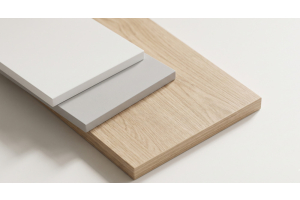
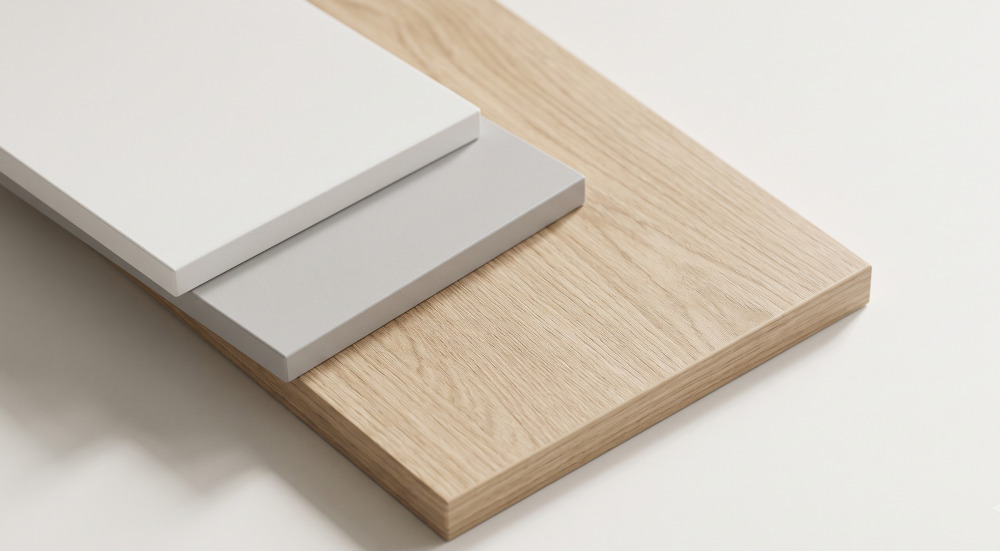
When building kitchen carcasses, it can often be difficult to separate MDF, plywood, and melamine board, especially if you aren’t an expert when it comes to sheet materials!
It’s a very common question, and if you’ve spoken to someone who went with MDF, that doesn’t necessarily mean plywood or melamine wouldn’t be a better choice for you.
So, here’s a straightforward breakdown that we hope helps you pick the right option before you cut a single sheet.
What Each Board Actually Is
MDF is short for medium-density fibreboard and is made from compressed wood fibres and resin. Dense, smooth, and consistent, it’s fantastic if you want to paint a kitchen unit, but it won’t thrive in moisture-prone areas and is heavier than most alternatives.
Plywood is built from cross-layered wood veneers bonded together. That cross-grain construction gives it serious strength and means it holds screws better than MDF. It's also lighter for its size, and moisture-resistant grades are available.
Melamine board is typically an MDF or particleboard core with a melamine-resin surface paper fused to it. The surface is already finished, easy to clean, and scratch-resistant, making it a popular choice for kitchen cabinets where speed and practicality matter.
Side-by-Side Comparison
Let’s look at how they compare:
Property | MDF | Plywood | Melamine Board |
Surface finish | Needs painting/veneering | Needs painting/veneering | Ready to use |
Moisture Resistance | Poor, as it swells and degrades | Good (WBP/marine grades) | Moderate (surface resists, edges vulnerable) |
Screw holding | Moderate (use inserts) | Excellent | Moderate |
Weight | Heavy | Medium | Medium-Heavy |
Machinability | Excellent | Good | Good |
Cost | Low-Medium | Medium-High | Medium |
Best for | Painted doors, mouldings | Carcasses, shelving, structural work | Kitchen carcasses, cabinet interiors |
Moisture Resistance Is The Big One for Kitchens
It’s important to actually think about practicality when it comes to all areas of kitchens.
After all, they get steam, spills, and humidity. Standard MDF will absorb moisture and swell over time, especially at cut edges. As such, you rarely see it used as the main carcass material in a wet environment. Moisture-resistant MDF exists, but it’s not a complete fix.
Plywood, particularly WBP (weather and boil proof) grade, handles moisture significantly better. The cross-ply structure doesn't swell the same way, and it won't delaminate under normal kitchen conditions.
In the middle of the two, you’ll find melamine boards. The surface is resistant to water and easy to wipe down. It works very well for visible interior surfaces, but the edges are the weak point and if they’re not properly sealed or edged with PVC tape, moisture gets in and the board can swell or delaminate over time.
Load-Bearing: What Can It Hold?
If you want to fit base units that will carry a worktop, pots, and heavy appliances, screw holding and structural rigidity matter.
Plywood is the victor here, with cross-grain layers meaning screws have more to grip, and the board itself doesn’t flex as much under load. For deep shelving, pan drawers, or anything taking sustained weight, ply is the safer choice.
While MDF may be pretty strong in compression, it is prone to sagging on long unsupported spans, and screw threads can strip in MDF over time. This is particularly common when units are assembled and dismantled more than once. Going for MDF carcasses? Use barrel nuts and connector bolts.
Melamine board (on a particleboard core) is the weakest of the three for load-bearing, and long horizontal runs will sag without a centre support. On MDF-core melamine, performance is better, but it still won't match ply for structural applications.
What is the Best Board for Kitchen Carcasses?
Melamine board (MDF core) is the go-to for most kitchen carcasses. It's dimensionally consistent, the interior surface is already finished, it's fast to work with, and it's cost-effective for production joinery. Seal your edges, support long horizontal runs, and keep it away from direct water contact.
Use WBP plywood if you need structural strength or moisture exposure. It's heavier and more expensive, but you'll thank yourself when those base units are still solid ten years later.
The answer is MDF for painted doors, face frames, and mouldings.
When to Use Each?
Use melamine board when:
You're building standard kitchen carcasses and want a factory finish
Speed of build matters and you don't want to add a finish step
You're doing volume work and need consistent, predictable sheets
Use plywood when:
The unit will bear heavy loads
There's a risk of moisture exposure (near a sink, dishwasher, or in a utility room)
You need strong screw retention and long-term durability
Use MDF when:
You're routing profiles, cutting detailed shapes, or making painted cabinet doors
You need a flat, smooth substrate for veneering or lacquering
Moisture isn't a concern
Get the Right Sheet from Joseph Parr Middlesbrough
At Joseph Parr Middlesbrough, we stock a full range of sheet materials for trade joiners. Whether you're pricing up a kitchen fit-out or restocking the van, we can sort you out with the right board for the job.
Get in touch with the team if you’re looking for specific guidance on finding the right sheet materials for your kitchen, or order yours online.